InkSmithery
Why Paper Art Prints Yellow Over Time — And How to Slow It
If you've ever pulled a print out of a drawer after a few years and found it's gone the colour of weak tea, you already know the problem. Paper doesn't stay put. It reacts — to light, to air, to whatever's touching it — and one of the first signs is that warm, slightly sad yellowing around the edges or across the whole sheet.
The good news is that it's slow, and most of it is preventable. You don't need a museum-grade setup. You just need to know what's actually causing it, because a lot of the advice floating around online is either overkill or slightly wrong.
What's actually going on inside the paper
Two things drive yellowing, and they often work together.
The first is lignin. Cheap paper — think newsprint, or budget poster stock — still contains lignin from the wood pulp, and lignin oxidises in light and air. That's why an old newspaper turns brown in weeks on a sunny windowsill. Better art paper is either lignin-free or has most of it removed, which is why a decent giclée print on cotton rag or acid-free stock behaves very differently from a supermarket poster.
The second is acidity. Paper with a low pH slowly eats itself. Worse, it can eat whatever's touching it — so an acidic mount board pressed against a nice archival print will happily transfer its problems across. This is why the mounting matters almost as much as the paper.
Add UV light to either of those, and you accelerate everything. Sunlight is the obvious villain, but ordinary daylight through a north window will still do damage over years. It's just slower.
Where you hang it matters more than what glass you use
I'd start with placement before I'd spend money on fancy framing. A south-facing wall that gets direct afternoon sun is the worst spot for anything on paper, full stop. Even with UV glass, you're only blocking a portion of the damaging wavelengths, and heat cycling behind the glass isn't doing the paper any favours either.
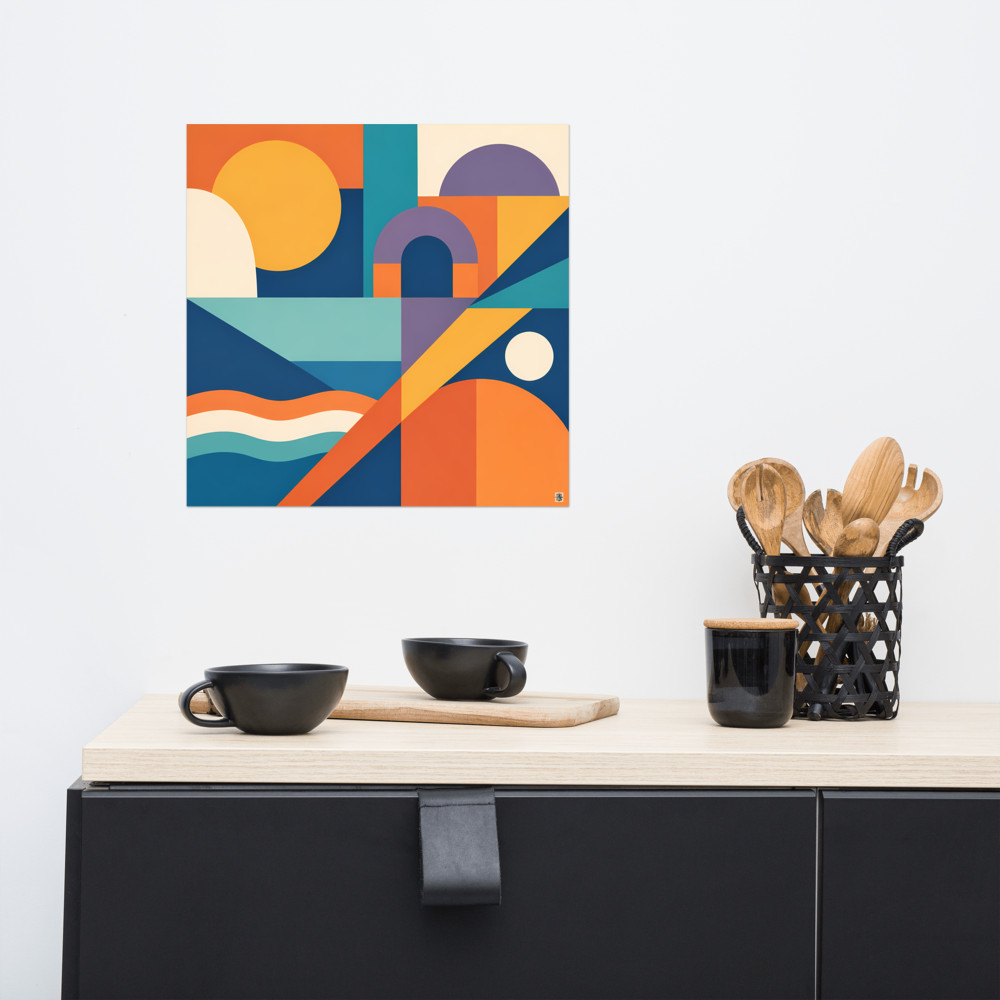
East-facing walls get a burst of morning light and then calm down. West-facing gets brutal evening sun in summer. North-facing is the safest by a long way — soft, indirect, consistent. If you've got a print you actually care about, like something with strong flat colour blocks where fading would be really visible — a piece like Harbour Steps with its saturated geometric shapes, say — that's the wall I'd choose.
If you have to hang something in a bright room, hang it on the wall opposite the window rather than adjacent to it. Reflected light is much gentler than direct.
UV glass and acrylic — worth it, with caveats
Museum glass and UV-filtering acrylic will block somewhere between 97% and 99% of UV, depending on the product. That's a genuine difference over a ten or twenty year span. It's not magic though. It won't stop yellowing from acidic mounts, it won't stop damage from humidity, and it won't help if the paper itself is poor quality to begin with.
Acrylic (sometimes sold as Perspex or plexiglass with UV coating) is lighter and shatter-resistant, which matters if you're hanging something large or above a sofa where a knock is possible. The downside is it scratches easily and can build up static that pulls loose pigment off pastels or charcoal — not usually a concern with printed work, but worth knowing.
Standard picture-frame glass from a high street shop offers almost no UV protection. It's fine for a print you're not precious about. For anything you'd be sad to lose, it's worth the upgrade.
The mount is the bit people forget
This is where I see the most avoidable damage. A print goes into a lovely frame, but the mount board underneath is the cheap cream stuff from a craft shop, and five years later there's a brown halo around the window where the board has been touching the paper.
Look for anything labelled acid-free, conservation grade, or ideally cotton museum board. The tape matters too — use archival linen tape or acid-free hinging tape, not masking tape and definitely not sellotape, which will yellow and lift within a couple of years. If a framer offers dry mounting, ask them not to for anything you might want to remove from the frame later. It's permanent.
A small detail: leave a millimetre or two of air gap between the glass and the print. Direct contact traps moisture and can cause the print to stick to the glass over time, which is a nightmare to reverse. The mount board does this job automatically if you use one, which is another reason to bother.
Storing prints you're not hanging
For archival print storage — prints in a drawer, a portfolio, or waiting to be framed — the principles are the same, minus the light. Keep them flat, interleaved with acid-free tissue or glassine, in a box or folder that's also acid-free. Not in the loft (heat cycling), not in the garage (damp), not in a plastic sleeve for years on end (some plastics off-gas and cause their own kind of damage — polypropylene and polyester sleeves are fine, PVC is not).
Room temperature and moderate humidity is what you want. If you're comfortable, the paper's comfortable.
Things I'd genuinely avoid
Direct sunlight, obviously. Hanging above a working fireplace or radiator — the heat and soot are both bad news. Kitchens and bathrooms if there's no extractor, because grease and steam settle on everything. Bluetack or drawing pins straight into the paper (I know, but people do it). And the classic mistake of rolling a print tightly for storage — it develops a memory curl that never quite comes out.
If you want to prevent art print yellowing in the most practical way: buy prints on decent paper to start with, frame them properly with acid-free materials and UV glass, and hang them somewhere the sun doesn't hit directly. A piece like Harbour Noon or Highbury Lawn, given that treatment, should still look how you remember it in fifteen years' time. Not because paper is invincible, but because you've stopped stacking the odds against it.
Related articles


Mentioned in this article