InkSmithery
When a Room's Doing Too Much: Calming a Busy Wall
There's a particular kind of tired you feel walking into a room that's trying too hard. Every surface has something on it. The walls are a patchwork of frames at slightly different heights. The sofa's got four cushions in three patterns and a throw with a fourth. Nothing is actually wrong, and yet your eyes can't settle anywhere. If you've ever sat down in your own living room and felt vaguely unable to relax, this might be why.
The instinct, when a room feels off, is usually to add something. A new lamp. Another print to fill that awkward gap above the radiator. A rug to tie it all together. Sometimes that works. More often, in my experience, the room needs the opposite — you need to take things away before you add anything else.
Start by seeing what's actually there
Before you move a single frame, take a photo of the wall on your phone. Something about the flatness of a photo shows you what your eye has been politely ignoring for months. You'll notice the leaning print behind the plant, the certificate that's been up since 2019, the little canvas that made sense in the last flat but doesn't quite work here. Photograph each wall separately. Look at them tomorrow with fresh eyes.
What you're checking for is competing focal points. A wall generally wants one thing to look at, or a considered group that reads as one thing. If you've got three medium prints spaced evenly, plus a mirror, plus a shelf with objects on it, your eye has nowhere to rest. It bounces. That bouncing is the tiredness.
The fix isn't usually to rearrange. It's to remove. Take everything off the wall. Everything. Live with the blank wall for a couple of days. It'll feel wrong at first — almost accusatory — but stick with it. When you start missing something specifically, that's the piece worth putting back first.
Negative space isn't emptiness
There's a difference between a bare wall and a wall with intentional negative space. Bare feels like you haven't got round to it. Intentional feels considered. The trick is usually one strong piece with generous room around it, rather than trying to fill the whole area.
A single 60cm print centred on a wall that could technically hold three will almost always feel better than three prints crammed in. The space around the piece is doing work — it's giving your eye somewhere to breathe between looking at things. Interior designers talk about this as "rest" and it's a genuinely useful way to think about it. Every busy element in a room needs a quiet bit next to it.
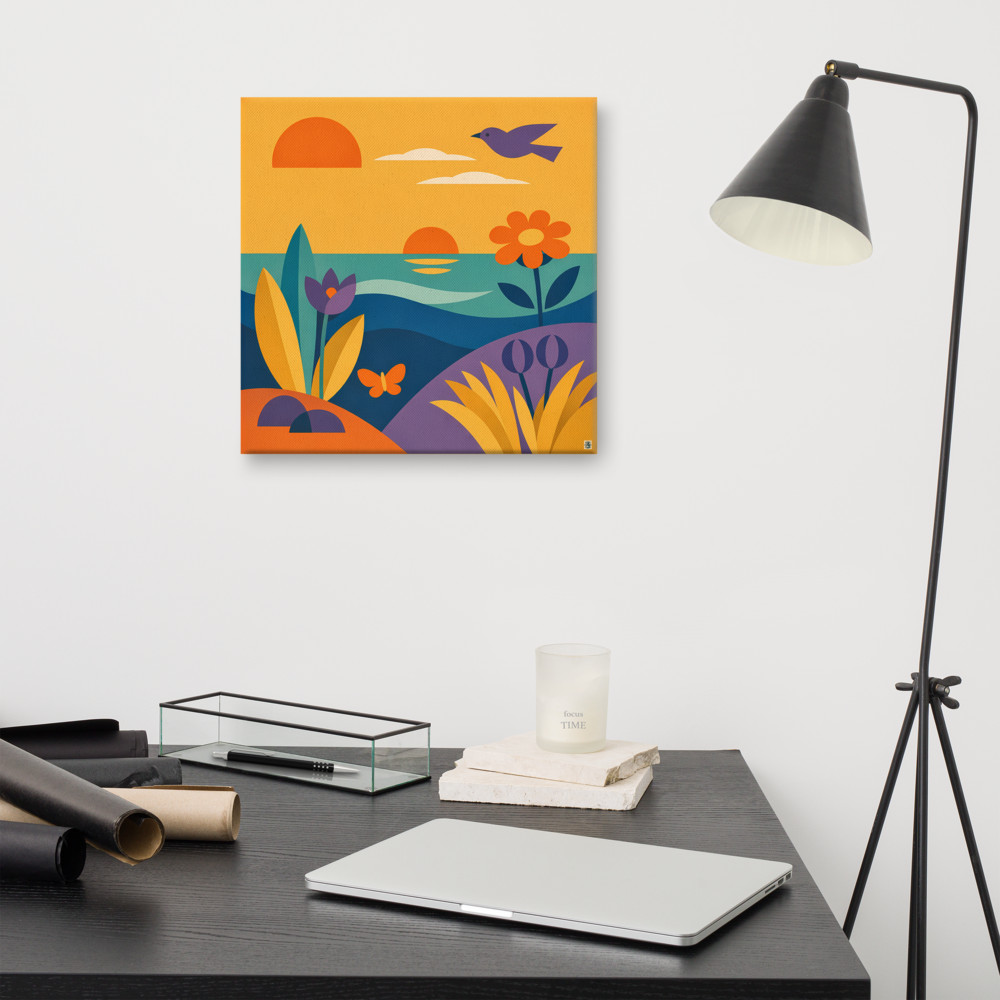
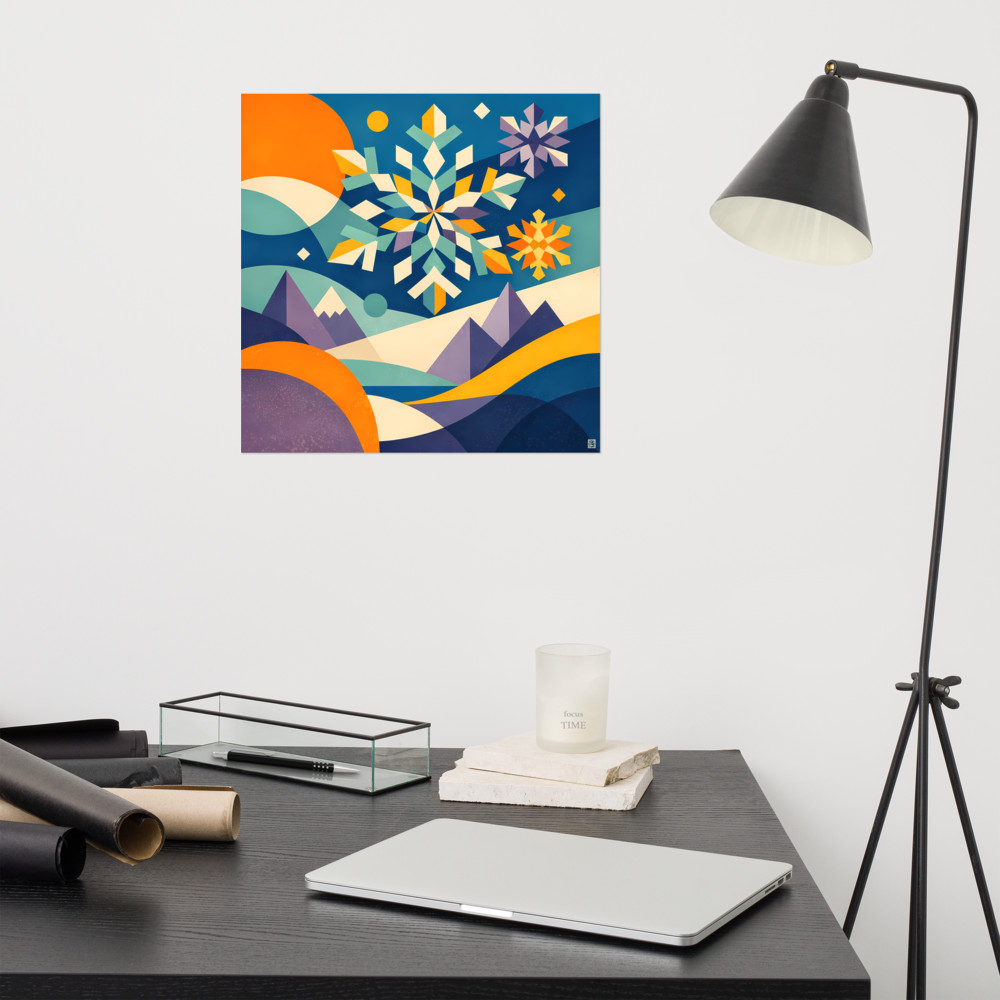
This is where the choice of print matters more than usual. If the rest of the room is already busy — patterned sofa, full bookshelves, a rug with a lot going on — the artwork needs to be the calm bit. Something like Sunward Haven, which has clear shapes and a limited palette, will sit quietly on a wall in a way that a densely detailed piece won't. It gives your eye a defined thing to look at and then move on from.
What "neutral" actually means here
Neutral doesn't have to mean beige, or that flat greige colour every rental seems to come in. Neutral, in art terms, means a piece that doesn't demand constant attention. It can have colour — quite a lot of colour, actually — as long as the composition is settled. A mid-century-style print with warm ochres and a soft blue can be more restful than a black-and-white photograph of a busy street scene, because it's about what the piece is doing compositionally, not just the palette.
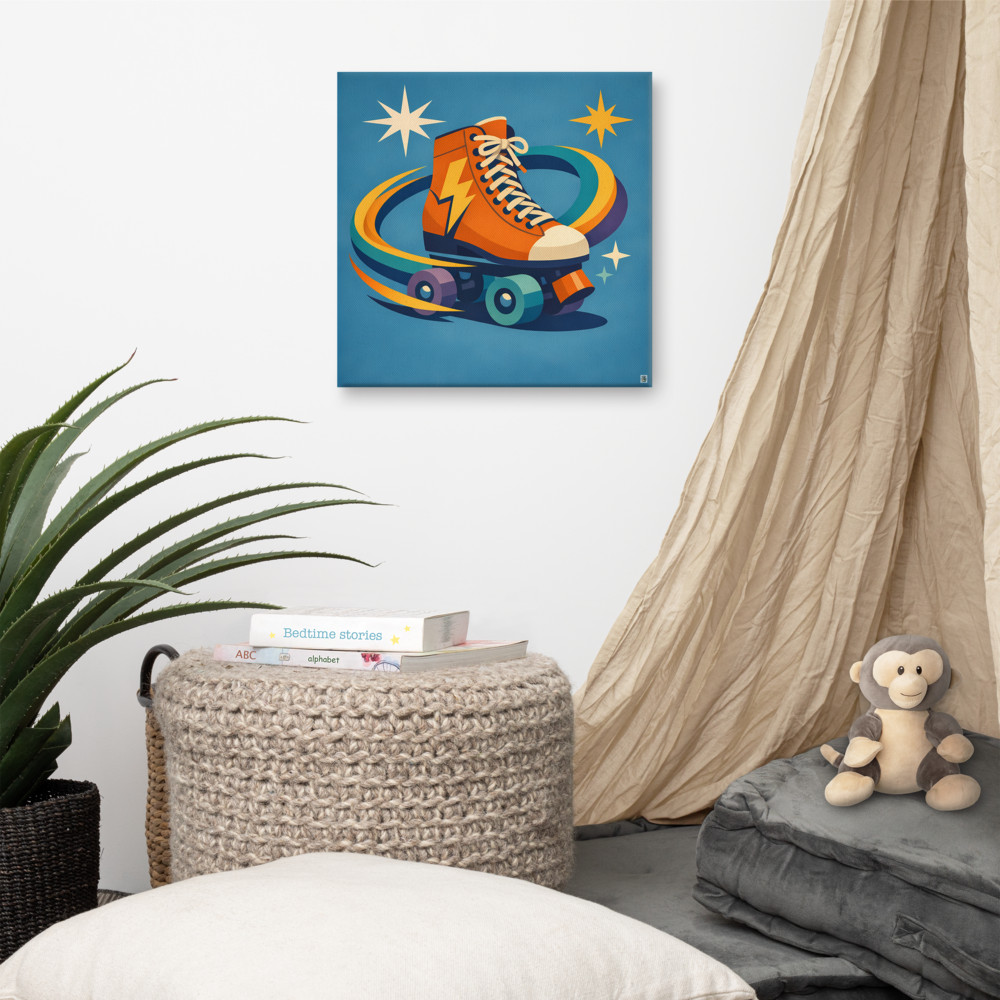
What you want to avoid, in an already-busy room, is a print that's fighting for attention with everything else. High contrast, lots of small details, competing subjects — those work brilliantly on an otherwise plain wall, but they'll add to the noise if the room's already loud. Save the punchier pieces, the Rink Signal types with movement and energy, for a space that can hold them. A hallway. A study with plain walls. Somewhere they get to be the main event.
The same logic applies to gallery walls. If you love the look, fine — but a gallery wall counts as one busy element, and you probably can't also have a heavily patterned sofa and a maximalist rug in the same room without something giving. Pick your loud moment per room and let everything else support it.
Removing before adding
Here's the exercise I'd genuinely recommend if a room's been bothering you. Take down two-thirds of what's on the walls. Put it in another room, or a cupboard. Live with what's left for a week. You'll be amazed how quickly your eye adjusts and how much calmer the room feels almost immediately.
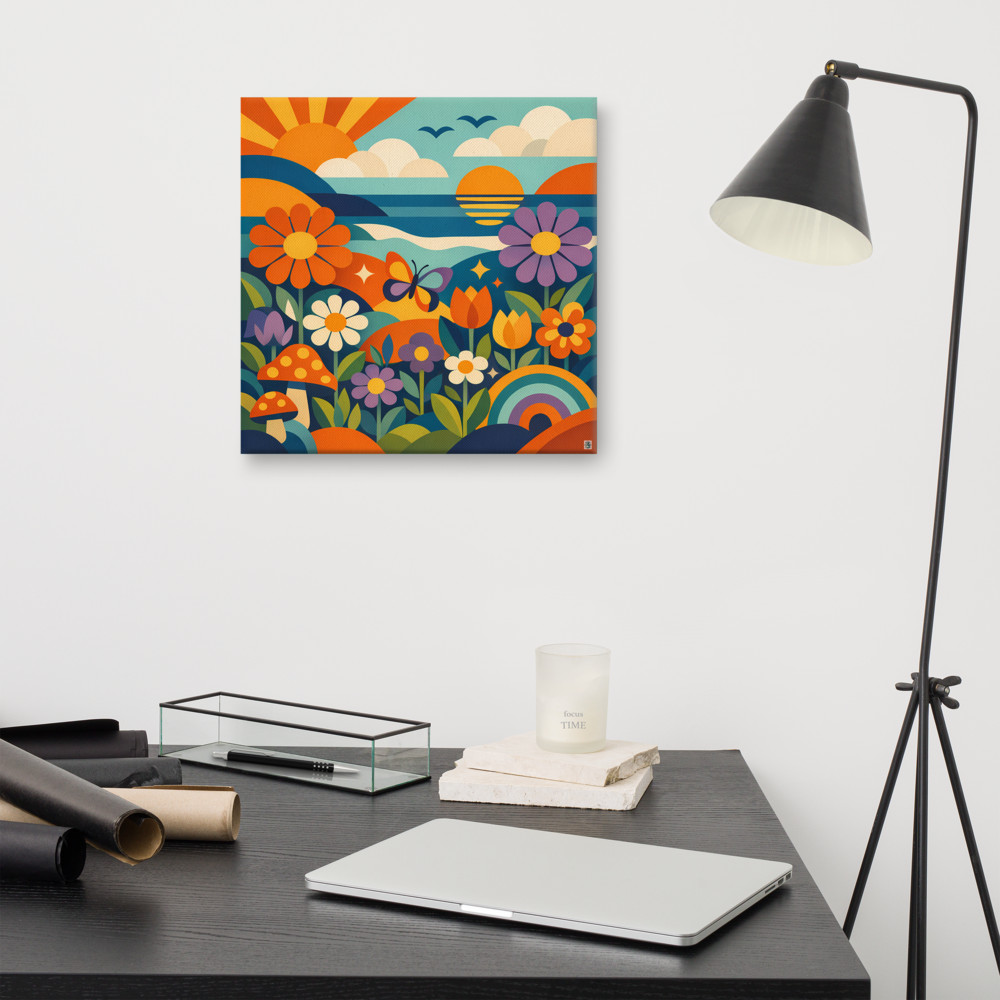
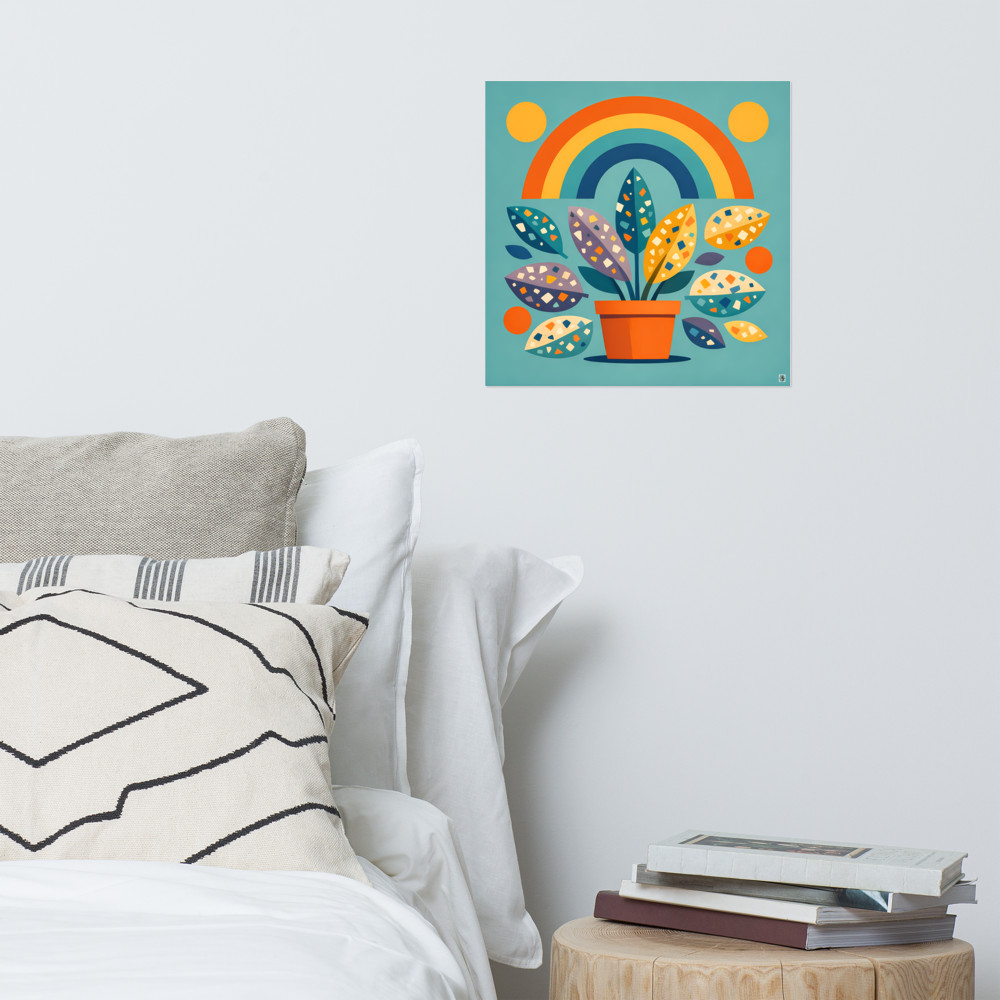
Then, and only then, think about what to add back. You might find you don't want to add much at all. You might realise that the one piece you kept — the one you didn't even hesitate about — is doing all the work you needed. Or you might decide the room wants one bigger, quieter piece where three smaller ones used to be, and something like Meadow Drift will hold a whole wall on its own if it's the right scale.
The rooms that feel best to be in are almost never the most decorated ones. They're the ones where every element has room to be itself. That's harder than it sounds, because it means saying no to things you actually like, and admitting that the print you loved in the shop doesn't get to live in this particular room. But once you've done it, you stop feeling that low-level agitation when you walk in. The room lets you rest, which is what a room's meant to do.
Related articles

Mentioned in this article